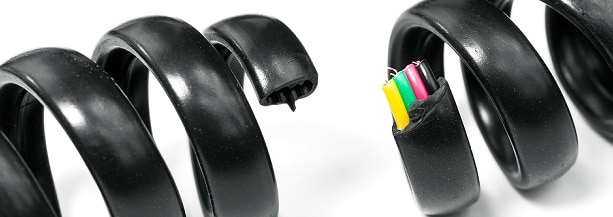
Whether you call it a coil cord, coiled cable or retractile cord we have all seen the spiral cords used in many applications. Coil cords are found in garage doors, your cell phone car charger, defibrillator paddles and simple key chains. Whatever the design goal the primary reason for using this type of solution is to put a lot of cable or wire into confined space and have it available to extend when necessary. Coil cords are a great way to accomplish this goal.
All coil cords have the same general shape, a straight section, followed by a coiled or curly section, followed by yet another straight section. The extension capability of a coil cord comes from the coiled or curly section. When the cable is pulled the coiled section acts like a spring and stretches.
Recently Meridian Cable was approached by a medical device company to solve a “spring” problem. The medical company’s device weighs about 1 pound and will be connected to a patient via a coiled cord. The medical company wanted the device to stay put when the cable was extended 5 inches, however they didn’t want the 1 pound mass of their device to pull on the patient if the device fell off a standard bedside height surface. This meant the device had to almost free fall for 22 inches.
The customer also had physical requirements for the coil diameter and overall cable length. The coil diameter could not exceed 0.60 inches in outside diameter and the overall cable length must be no longer than 42 inches. The coiled diameter could be smaller and the retracted length, or coiled section, could be adjusted.
To solve this problem the following force parameters were established. At 5 inches extended the force must be less than 0.25 pounds and at 22 inches extended the force must be between 1.0 and 1.25 pounds. The 5 inch force was designated “B” and the 22 inch force was designated “C”.
Several cable constructions were made, but all of them had 6, 24 awg conductors. We settled on two cable designs with the primary difference being the type of shielding used. Testing was performed over several days using various configurations and the results were achieved.
| SAMPLE # | CABLE # | RETRACTED LENGTH (Inches) | ROD OD (mm) | COIL OD (inches) | “B” FORCE (pounds) | “C” FORCE (pounds) |
| 1 | 3 | 6.25 | 5 | 0.55 | 0.55 | 2.20 |
| 2 | 3 | 6.25 | 6 | 0.57 | 0.53 | 1.43 |
| 3 | 3 | 6.25 | 8 | 0.68 | 0.13 | 0.66 |
| 4 | 3 | 5.5 | 4 | 0.54 | 0.59 | 2.50 |
| 5 | 4 | 6.38 | 5 | 0.55 | 0.44 | 1.60 |
| 6 | 4 | 6.75 | 6 | 0.57 | 0.42 | 1.30 |
| 7 | 4 | 6.75 | 8 | 0.68 | 0.08 | 0.62 |
| 8 | 4 | 6 | 4 | 0.54 | 0.88 | 2.70 |
| 9 | 3 | 6.25 | 7 | 0.61 | 0.26 | 1.01 |
| 10 | 3 | 10.25 | 6 | 0.57 | 0.13 | 0.77 |
| 11 | 3 | 4.25 | 8 | 0.68 | 0.31 | 1.10 |
| 12 | 4 | 6.38 | 7 | 0.61 | 0.29 | 1.01 |
| 13 | 4 | 10.5 | 6 | 0.57 | 0.18 | 0.77 |
| 14 | 4 | 4.38 | 8 | 0.68 | 0.24 | 1.03 |
Based on the above data specific samples were made for the customer to test. To see a video of the coil cord manufacturing process just click this link – http://www.youtube.com/watch?v=PG741GMdE-I&feature=channel_video_title
Should you need a standard coil cord or a custom design coiled cable Meridian Cable can help. Meridian Cable has over 30 years of experience designing and manufacturing coil cords, coiled cables and cable assemblies. Designed – Built – Delivered, Meridian Cable is ready to help create a solution for you.
We have all seen them, those curly wires that are used to connect things and stretch like a spring. Coil cords are found in garage doors, your cell phone car charger, defibrillator paddles and simple key chains. Coil cords are a great way to attach two items where one or both need to move. Whatever the application knowing how and what mechanical tests are needed to verify a coil cord design is critical in achieving proper performance.
All coil cords have the same general shape, a straight section, followed by a coiled or curly section, followed by yet another straight section. The extension capability of a coil cord comes from the coiled or curly section. When the cable is pulled the coiled section acts like a spring and stretches. It is this mechanical stretching that makes this type of cable assembly critical in certain applications.
Since a coil cord is a dynamic assembly care must be taken to ensure the design will last the expected life of the product. Advanced life testing is one way to verify the design meets the required specifications and can perform as expected. The testing discussed in the article are Cycles to Failure, Retraction Compliance and Cable Flexing to Failure.
Coiled cables are springs made from raw cable that is typical composed of copper and plastic. As we have all seen, if copper or plastic is repeatedly flexed it can fatigue and eventually fail. When a coiled cable is extended and then retracted flexing is occurring. This flexing, over time, will fatigue the materials. The best way to determine if the design can withstand this process is to perform a Cycles to Failure test.
In a Cycles to Failure test a coiled cord or cords is attached to a test machine that can be programmed to extend and retract the cable. The test machine’s extended length, cycle speed, extension dwell and retraction dwell can all be programmed. For example the machine could be set to 110% of designed extended length, a cycle speed of 30 per minute, an extension dwell of 10 seconds and a retraction dwell of 20 seconds. The machine would then cycle the cable or cables until an open circuit occurs indicating failure. All the parameters can be changed to align properly with the intended application.
In a Retraction Compliance test the cords are attached to the cycling machine and cycled. However before cycling the coil cable’s initial retracted length is measured. After cycling the cable is allowed to rest for a period of time and then the cycled retracted length is again measured. Retraction Compliance is defined as a percentage of cycled retracted length to initial retracted length. These percentages can range from 50% for a very poor or heavily cycled coiled cable to 95% plus for a well designed assembly.
The Cable Flexing to Failure test is used to make sure the raw cable used itself can withstand fatiguing. The coil cord is made and sections of the cable, both the coiled section and straight section, are attached to programmable cable flexing machine. The machine’s flex radius, cycle speed and rotation angle can all be customized to ensure the cable meets the desired requirements. For example the flex radius could be ½”, the cycle speed could be 60 per minute and the rotation angle could be 180 degrees. The machine would then cycle the cable until an open circuit occurs indicating failure. All the parameters can be changed to align properly with the intended application.
Designing a coiled cable properly is critical. Over engineered and the cost is too high; under engineered and the performance is inadequate. However the only way to ensure the design is correct is through testing. There are two types of testing. Lab based, programmable testing which Meridian Cable performs, or field testing which everyone who buys a coil cord eventually does. In many cases the lab based testing before field launch will help ensure a proper cable is designed, manufactured and delivered.
Should you need a standard coil cord or a custom design coiled cable Meridian Cable can help. Meridian Cable has over 30 years of experience designing and manufacturing coil cords, coiled cables and cable assemblies. Designed – Built – Delivered, Meridian Cable is ready to help create a solution for you.
We have all seen them, those curly wires that are used to connect things and stretch like a spring. Coil cords are found in garage doors, your cell phone car charger, defibrillator paddles and simple key chains. Whatever the application knowing how to specify a coil cord is critical in achieving the design goal. Coil cords are a great way to attach two items where one or both need to move and this article will give you the basics needs to specify one.
All coil cords have the same general shape, a straight section, followed by a coiled or curly section, followed by yet another straight section. The extension capability of a coil cord comes from the coiled or curly section. When the cable is pulled the coiled section acts like a spring and stretches. One of the key factors affecting the stretching ability is the material used to make the raw cable.
A coiled cable is only as good as the material used to cover the copper stranding and for the out jacket. So knowing the materials available and how well they perform is critical. This is where an expert designer can help tremendously and below are some materials to consider along with their basic performance characteristics.
The inner conductor jacket material can be polyvinyl chloride (PVC), polypropylene (PP) or polyethylene (PE). These basic materials all have pros and cons. PVC is the least expensive but also has lower performance. PP and PE are a bit more expensive and allow the conductors to move more when the coiled cord is stretch which enhances retractablity.
The outer jacket material is perhaps the more critical of the two material considerations. Choices can range from PVC, to polyurethane (PU) and thermoplastic elastomer (TPE). PVC has the weakest retraction capability, PU has the strongest and TPE will usually have the longest life. Other materials are used for special applications but are not as common, although their performance characteristics can be quite impressive.
Should you need a standard coil cord or a custom design coiled cable Meridian Cable can help. Meridian Cable has over 30 years of experience designing and manufacturing coil cords, coiled cables and cable assemblies. Designed – Built – Delivered, Meridian Cable is ready to help create a solution for you.
If you are not familiar with the industry, coil cords and cable assemblies are items easily looked over and taken for granted. You might not realize just how prevalent they are and how much of a part of daily life they encompass. If you stop to take a look around you, coil cords and cable assemblies are everywhere. Due to their unique applications and locations, the standard coil cord and cable assembly are no longer “enough”. There is a growing need for “custom” coil cords and cable assemblies to accommodate the ever changing world and environment we live and participate in on a daily basis.
What are some of these unique applications and locations that a custom cable manufacturer may be able to provide solutions to a customer? They can include, but are not limited to: medical devices and operational equipment, surveying equipment (for which UV inhibitors and special materials can be used to make the coil cords and cable assemblies weather and animal proof), security devices, and operational assistants in daily activities.
Where can one see these coil cords and cable assemblies in action and being used in practical day to day applications? A few of these can be found at big box retailers, in hospitals, on construction sites just to name a few. If one were to look close enough, they would find coil cords and cable assemblies to be everywhere.
When is a custom manufacturer the one for you? A custom manufacturer can offer a more personalized approach to answering your specific application and need. Not all coil cord and cable assembly needs are the same nor are they a standard size. A custom manufacturer can evaluate your need, environment and individual solution and, with their team of engineers, can create a product that will offer you a customized solution to answer your specific need.
While this is just a generalized overview to explain the benefits of seeking out a custom coil cord manufacturer, please feel free to contact one of the experienced team members at Meridian Cable to answer your custom coil cord and cable assembly questions.
Emily Mierzejewski
Customer Manager
Meridian Cable
Anyone who has designed, purchased or used a CUSTOM COIL CORD has run into the problem from time to time. There are two electronic assemblies and data or power needs to pass between them but nothing exists in stock that will work. What to do? The best solution is often a custom design. But that is often costs too much, takes too long and is too difficult to design right? It doesn’t have to be if the following pitfalls are avoided.
First, make sure the vendor can do the work. I know this sounds simple but often it is overlooked for some reason. Some great questions to ask are:
- Does the vendor extrude wire and cable?
- Is the vendor UL certified? ISO certified?
- Does the vendor add connectors, over mold, ultrasonic weld, attach electromechanical assemblies?
- Can the vendor design the wire, cable, coil cord, connector, over mold, housings?
- Is the vendor’s engineering “in house”?
- Can the vendor perform advanced life testing?
Second, make sure the vendor can support your logistic needs. Some questions to ask are:
- Does the vendor accept blanket orders?
- Can material be built ahead and warehoused?
- Does the vendor have multiple inventory locations?
- Is the vendor capable of shipping directly from the factory?
Third, make sure the vendor is cost sensitive. Some questions to ask:
- Does the vendor provide free engineering design?
- Is warehousing a service or cost?
- Does the vendor operate in a low cost manufacturing environment? Offshore?
- Does the vendor operate in multiple locations? Countries?
- Can the vendor provide a complete assembly, or just the cable?
In summary there are 3 key questions to ask. Can the vendor do ALL the work needed to make a complete product? Does the vendor have sufficient support services to take care of ALL the needs you have? Is the vendor positioned to make sure ALL costs are maintained? These are just a few questions that should be asked of any potential vendor you will hire to make CUSTOM COIL CORD.
Many people are gullible enough to believe that EVERYTHING imported is of poor quality. This simple defies logic and anyone who makes a blanket statement as such surely doesn’t know the world we live in today. Meridian Cable makes coil cords in China, designs them in America and is creating jobs in BOTH countries. This cannot be said by some of our competitors.
First let’s address the quality issue. If you have bought a cell phone, laptop computer, television or many other electronic devices odds are it was imported. The same is true for many, many other items. Kitchen appliances, furniture, medical devices, industrial controls and caskets are just a few of the items imported into America from overseas. If the argument is true that everything imported is of poor quality how is it that there are excellently made examples of every item listed here? The same is true of coil cords and cable assemblies. The truth is you can find poor quality manufacturing ANYWHERE, and that includes America. The important thing is to find a reputable company with a long history of quality performance.
Second let’s discuss why anyone would make such a blanket statement. There are great manufacturing companies all over the world, and there are very poor manufacturing companies all over the world. In this day and age surely everyone knows that excellent performance is not limited to any nation. Anyone who thinks one country has all the advantages is limiting their option. Granted there are reasons to buy from a given country and those do count. However if quality is the only criteria then there are many countries that qualify. The same is true of coil cords and cable assemblies. The truth is you can find companies at each end of the quality spectrum in most countries. A smart assessment would include ALL companies that can perform and not limit the options based on geography.
Third it is helpful to remember how small the world is today. Sure the earth has not changed size in our lifetime, or for a few billion years for that matter, but from a business standpoint the world has never been smaller. It took Christopher Columbus 5 weeks to cross the Atlantic in 1492, the first steamship took 18 days, Lindbergh 33.5 hours and today a modern jet makes the journey in 7 to 8 hours. Technology has continuously made the world smaller with each passing generation. Anyone who denies this fact is either purposely not telling the truth or is clinging to a lost world.
Last we all need to remember our business history. There are countless examples of countries and companies who close themselves off to the options the world can afford. China for example in 1100’s had paper, gunpowder and the compass CENTURIES before Europe. And in the 1400s, 80 years before Columbus’ voyage they had 400 foot long, ocean going boats while Columbus’ boats were about 70 feet long. China closed their borders, burned their boats, and was not a serious economic power for the next 500 years.
The point is obvious; any company that wants to grow and be competitive has to take advantage of every opportunity and resource available. Anyone who says ALL the advantages are in ONE country is either not being honest, or is myopic and denying reality. In today’s business environment, with the advancing in communication and logistics, any company can buy from any other company. All it takes is find thing right partner. When it comes to coil cords and cable assemblies Meridian Cable, being a global company, can be the best partner an OEM can find. And we have added many jobs in AMERICA over the last few years, so if you are worried about American job creation Meridian Cable is doing that too!
Whether you call it a coil cord, coiled cable or retractile cord we have all seen the spiral cords used in many applications. From garage doors, to cell phone car chargers, to medical equipment these cables are critical in achieving many design goals. Whatever the design goal the primary reason for using this type of solution is to put a lot of cable or wire into confined space and have it available to extend when necessary. Coil cords are a great way to accomplish this goal.
All coil cords have the same general shape, a straight section, followed by a coiled or curly section, followed by yet another straight section. The extension capability of a coil cord comes from the coiled or curly section. When the cable is pulled the coiled section acts like a spring and stretches.
For many applications the time required for a coiled cable to retract from its full working length is critical. A number of factors influence the retraction speed of a coil cord but one important consideration is the raw cable’s geometry. This geometry is typical round, but in special it can be rectangular or even ovate. The advantages of each shape and the corresponding “bean effect” are explored below.
Every coil cord requires forces to extend it. That force comes from the unwinding of the coils themselves but also from the bending of the raw cable along its length. If viewed from the individual coil perspective what is happening can best be described as beam being bent. In a round geometry the force required in any given direction is equal. An easy way to visualize this is with a metal coat hanger. If a straight section is held tight at one end and the other end pushed from the side, from the side, the force required to bend it in any direction would be very similar. While other factors such as fabrication stresses, molecular orientation or grain do have an effect to some degree it is quite minimal in this application. This design creates a coil cord with a typical retraction speed.
In order to achieve a faster retraction speed a coiled cable made from a rectangular shape cable can be used. The rectangular shape adds force that can be best visualized using a ruler or a regular 2 X 4 board. When these are laid flat with something supporting just the ends the middle is free to bend, and depending on the length it can bend quite easily. However if the direction is changed and these are placed on edge they will not bend much at all. When a coiled cord is made using a cable with a rectangular cross section this resistance to bending, or “beam effect”, augments the spring effect of the coils and creates a coil cord with a higher retraction speed.
Sometimes a round geometry is too slow and a rectangular geometry too fast. In these instances a cable with an oval geometry can be used. Since this cable is not round it has a higher beam effect, however since the cable is not fully rectangular the beam effect is less. As one can imagine there are many variations between round and rectangular. All the options lead to many design opportunities when designing a custom coil cord.
Should you need a standard coil cord or a custom design coiled cable Meridian Cable can help. Meridian Cable has over 30 years of experience designing and manufacturing coil cords, coiled cables and cable assemblies. Designed – Built – Delivered, Meridian Cable is ready to help create a solution for you.
Slow motion video has changed and the cable assemblies used to transmit the data have too. Meridian Cable was approached by a manufacturer of the camera used in this video: Video: Power Game .The customer contacted us about a custom coaxial cable assembly and we now supply them with coaxial cable assemblies that perform every bit as well as the players in the video. The video shows a great example of slow motion video in the age of high definition cameras.
All of us have seen a coaxial cable. It has a center conductor, some insulation around the center conductor, then shielding over the insulation and finally an outer layer of material called the jacket. If you have ever set up “cable” to your TV you have most likely handled and RG59 or an RG6 coaxial cable. These cables are wonderful for basic cable, but won’t work at all for this video.
Meridian Cable’s customer needed FIVE coaxial cables inside a cable about the size of the RG59 or RG6 mentioned above. These coaxial cables needed to be RG174 or RG316 equivalent and be completely insulated from the other coaxial cables in the bundle. And to start they didn’t want to have to buy 25,000 feet.
We were able to design this cable and run a sample quantity of only 1,000 feet. This is truly what a custom cable assembly vendor like Meridian Cable should do.
As you watch the video remember that these are high performing athletes, and their power and grace makes what they do look easy. Manufacturing a custom coaxial cable assembly is no different. Meridian Cable makes designing and building custom cable assemblies look easy, and we do that every day for clients like you.
When you need a custom cable assembly or coil cord Meridian Cable can make your search easy.
Bud Kinzalow
Meridian Cable
We have all seen them, a coiled cable that makes connecting two electronic devices so much easier. The benefits of a coiled cable are numerous, but the main purpose is so that a big pile of excess cable doesn’t lie around and get tangled. A coiled cable can also be called a coil cord, coiled cord, curly cord, coiled wire or stretch cord to name just a few other names. All these names are used in this article, but they all mean the same product. The question, how to make a coiled cable? Is answered below in four steps.
As with many things experience plays its part, so it is always best to consult with experts like Meridian Cable.
STEP ONE is to make a cable. This can be as simple as one conductor or as complicated as a cable Meridian Cable recently made. That coiled cable had 15 conductors; five twisted pairs, two 14 awg conductors, two 18 awg conductors and one 50 ohm coaxial cable. Most coiled cables are not this complicated, but Meridian Cable can do it.
Since a coiled cable acts as a spring it is critical when making the cable that all the conductors are constructed right. Things to consider are the size of the conductor stranding, the twist of the stranding, the direction in which the conductors are bundled and the insulation material used to name a few.
The final cable consideration is the outside jacket material. This is critical because this is where most of the “coil” action in a coiled cable occurs. Meridian Cable uses the following materials; polyurethane, thermoplastic rubber, thermoplastic elastomer and polyvinyl chloride. Each material has applications it is suited for and these can range from medical uses to simple industrial control situations.
STEP TWO is to wind the cable onto a rod. During this process the coiled cord starts to look like the final product. The cable is wrapped around a rod the can be a small as 1/4 of an inch to a large as 3 or 4 inches in diameter. The size of the rod creates the inside diameter (ID) of the coiled cable. A small ID creates a coiled cord with more spring action and a larger ID creates less spring action.
STEP THREE is heat treating. Since the outer jacket material is thermoplastic it can be softened with heat. However too much heat will melt the material and too little won’t change anything. The goal is to heat the material JUST hot enough and for JUST the right amount of time to get it to stay in the coiled shape. This requires some experience and know how because if it isn’t done right then the coiled cord won’t perform correctly.
STEP FOUR is reverse winding. During heat treating the material on the outside of the coil cord is lengthened and the material on the inside is shortened. When the coil cord is reverse wound, or turned inside out, the force pulls the coils together giving the coil cord the spring action.
While these are the basic steps in making a coiled cable there are a lot of details that need to be considered. A few things to consider are how many cycles will the coil cable experience, what kinds of environment will the coiled cable endure and what electrical properties are vital for proper performance. Meridian Cable has the experience to talk you through the design considerations and show you how a quality coiled cable performs. Call us and we will be happy to design your next coiled cable.
Bud Kinzalow Meridian Cable
At Meridian Cable our tag line is “Off Shore In Spec On Time™” and we specialize in custom coil cords and custom cable assemblies. Since most products we build are designed, tooled and built exclusively for our customer’s many folks believe our lead times would be quite long. This is far from the truth.
Recently Meridian Cable was fortunate enough to work with a new customer who was in a bit of a pinch. This company was in Hawaii filming a sequel to a major motion picture, and they needed some custom coil cords fast.
The common perception is lead times from China, where our wholly owned factory is located, are months long. We shipped this order in less than one month from first contact.
Our new customer found us through an internet search, sent us an email and we had a quote to them in 2 days. Again this is a custom coil cord and not something we keep in stock. If this had been one of our stock coil cords we could have shipped the same day. We designed, costed and quoted this product in 2 days, and then proceeded to deliver them to the customer in less than 4 weeks.
To put some perspective on how quick this is, an explanation of how a coil cord is made will help. The first step is to build the inner conductors. This starts by taking individual copper strands and combining them to make the gauge wire needed. Step two is to cover this wire with an insulation material such as PE, HDPE, PP or PVC. In step three we combined three 26 gauge wires and a 24 gauge drain wire together in a bundle. Step four was braiding whereby the wire bundle is cover in a shield made up of 64 inter woven strands. In step five we did the final extrusion with PU, polyurethane. All these steps just made the raw cable; we still had to make the coil cord.
Coiling cable involves winding the raw cable around a metal rod. The size of the rod and length of the winding will determine the size of the final product. After winding the rods are put through a heat treating and cooling process to make sure the raw cable holds the curly cord shape that gives the product its retractablity.
Then all we had to do was ship the product, from China to Hawaii, where our customer was on location shooting their film.
All this was done in less than 4 weeks. This is what “Off Shore In Spec On Time™” means at Meridian Cable. Call or email us and see how we can help solve your custom coil cord or cable assembly needs.
Bud Kinzalow Meridian Cable